Indeed it works…
I continue while I’m at it with the exercise for Monks dataset, now moving on to the slightly more complicated second problem.
Intro
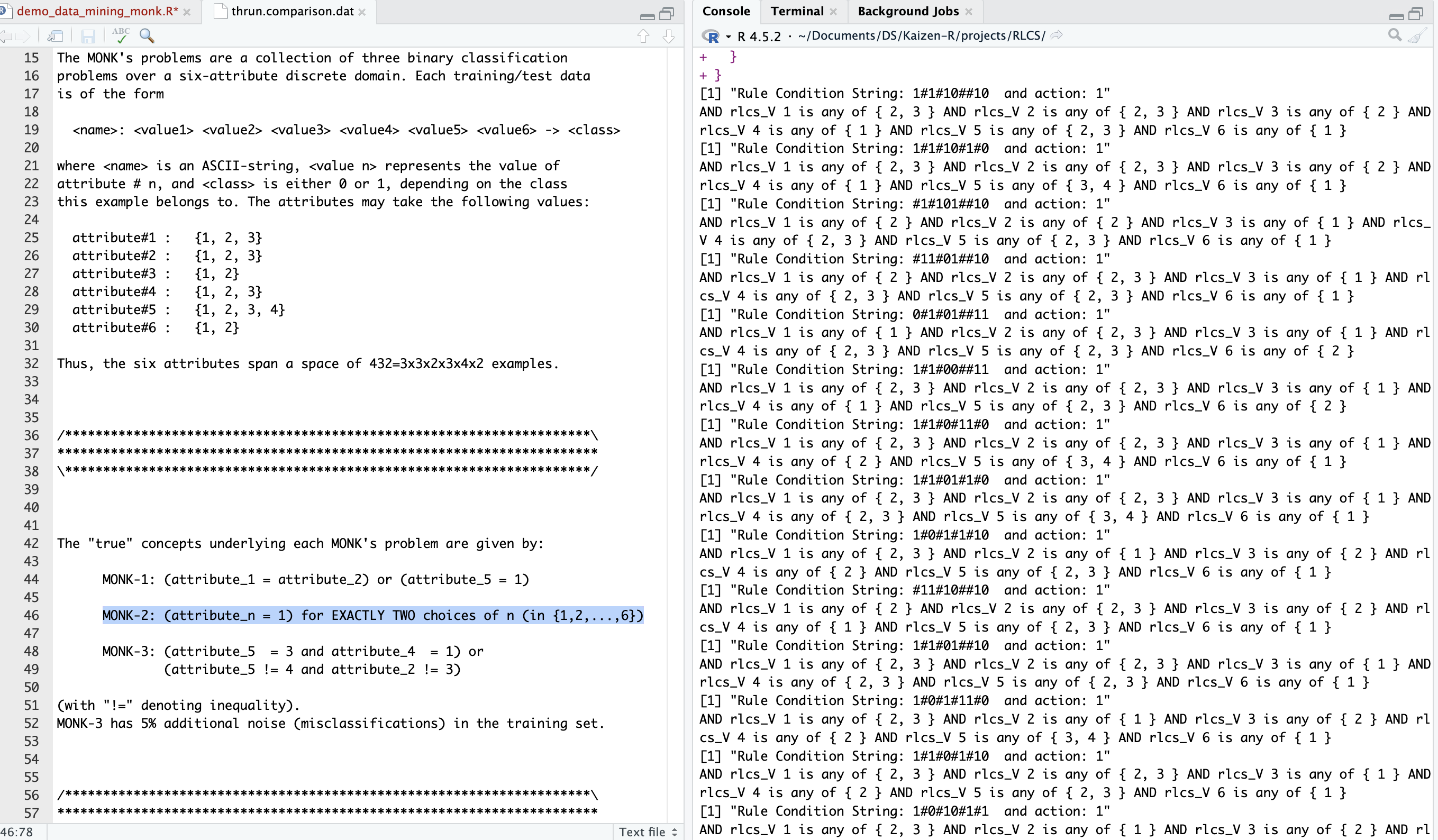
The second Monk problem involves controlling for all variables so that exactly two of them are equal to 1.
Let’s look at what RLCS produces for it.
Perfect results
First the results, so as to understand this: It works perfectly.
Interpretation
I haven’t checked every single rule, granted, but if you look at the profile and the rules definitions, you will see how this works:
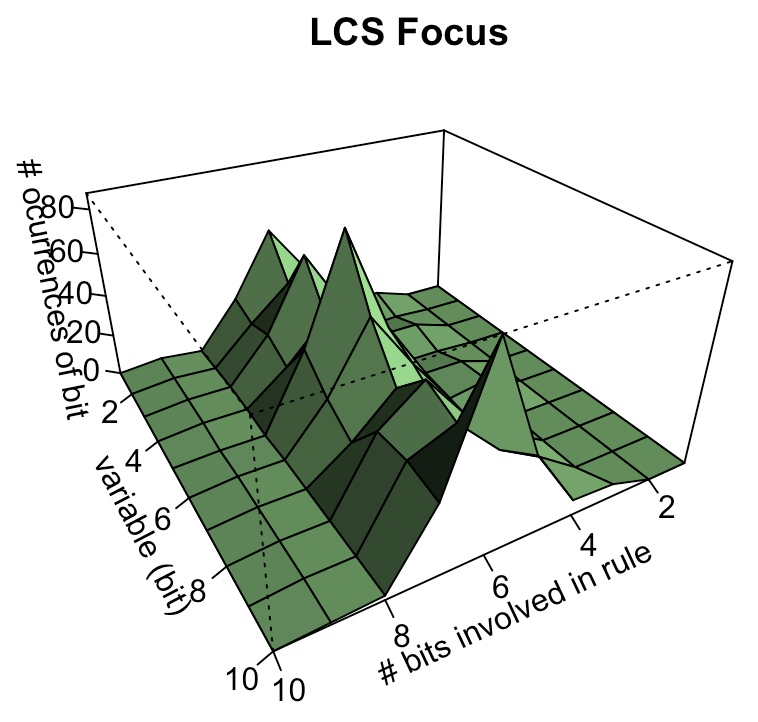
So there are usually 6/10 bits involved as fixed in a rule. To understand that, you need to see how we encode the variables. Some are in sets of values {1,2}, others {1,2,3,4} or {1,2,3}. (That last set is sub-optimal for RLCS, because it uses up 2 bits per variables. Never-mind that.)

The logic holds!
The bits variables with exactly one bit are involved more often (when there value is 1).
The bits with 3 values are less often involved because some specify 1. Same for sets of two bits for 4 values. Anyhow, the profile makes sense.
And so does the resulting profile for the population of rules generated by the RLCS package for this data mining exercise.
On parallel running
As there are quite a few more rules involved here, and consolidating them might take time, I went ahead and ran it in parallel (using the built-in RLCS options), so as to give it more time to look for better rules, that’s it.
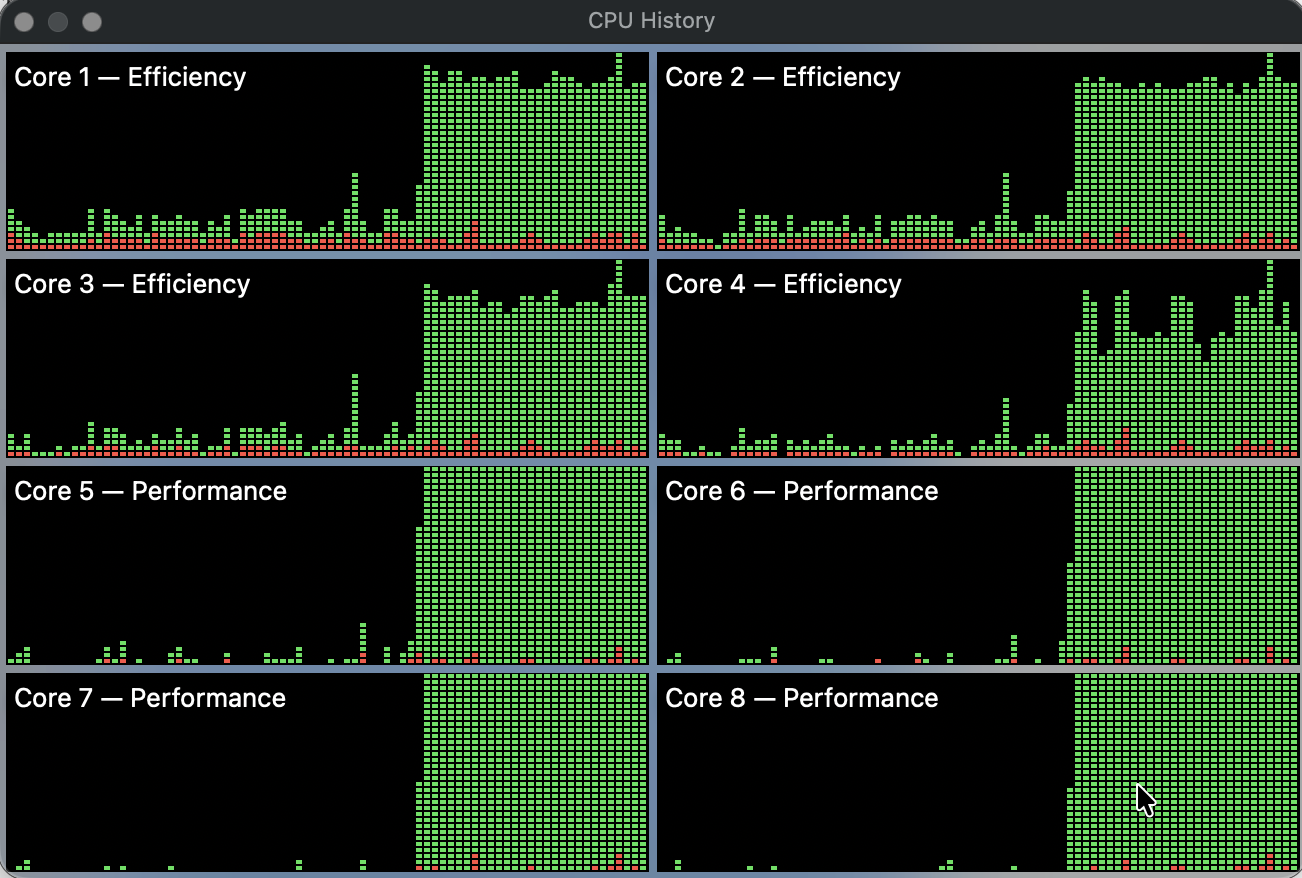
It’s only because I don’t want to wait for several minutes when I can wait for 2. But it changes nothing about the concept.
Conclusion
Well, it works. Confirmed. On harder problem, it takes more processing, sure. But it gets to the perfect results regardless.
References
These are the same references as yesterday.
The Paper that motivated this entry: https://link.springer.com/chapter/10.1007/3-540-45027-0_12
Which I found here: https://link.springer.com/book/10.1007/3-540-45027-0
Original Dataset copy (AFAIK), but with bad certificate: https://archive.ics.uci.edu/dataset/70/monk+s+problems
Official citation: Wnek, J. (1993). MONK’s Problems [Dataset]. UCI Machine Learning Repository. https://doi.org/10.24432/C5R30R.
Same dataset on Kaggle: https://www.kaggle.com/datasets/lavagod/monk-problem