Intro
It just kinda makes sense:
In R when you call a function with variables, by default, objects are passed, and IF you change one of the objects, a copy of it is first created, then changed. It doesn’t change in the calling environment, so it’s somewhat safer…
However, there is a way to avoid it, and behave slightly more like a C pointer thing: Pass environment references.
No copies. Just changes on the same object…
And here goes the reason of this post: If you pass an object, a large one at that, and you mean to change it in a function, and then return the resulting changed object: You create a copy in each iteration of the loop. Which seems sub-optimal.
Well… It is.
Results first
Here is the summary:
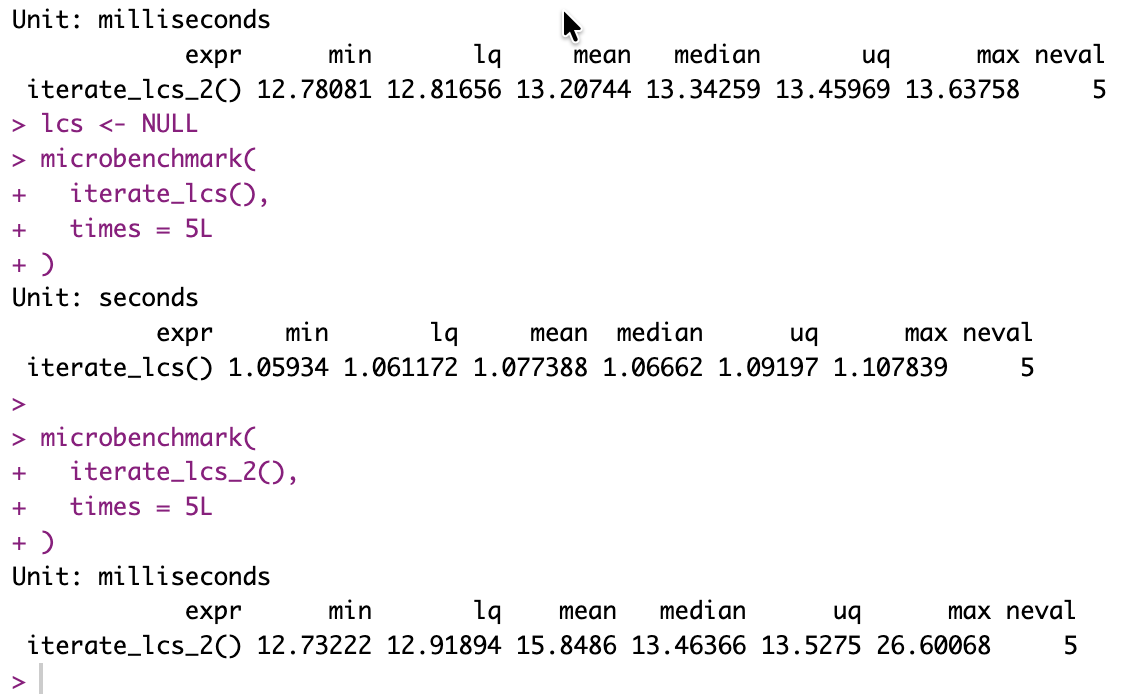
There you have it, look at the units! Milliseconds instead of seconds.
But you don’t have to take my word for it.
The Code for today
library(microbenchmark)

## Variable-passing, with copy-on-modify
add_random_num_to_list <- function(lcs = NULL) {
  if(is.null(lcs)) lcs <- list()
  lcs[[length(lcs)+1]] <- round(runif(1), 4)*10000
  lcs
}

## iterating to gather some time count...
iterate_lcs <- function() {
  lcs <- list()
  for(i in 1:10000) {
    lcs <- add_random_num_to_list(lcs)
  }
  lcs
}

## Modify variable in parent env:
add_random_num_to_list_parent_env <- function(env) {
  env$lcs[[length(env$lcs)+1]] <- round(runif(1), 4)*10000
}

## Same exact functionality as the other, but using environments (ref)
iterate_lcs_2 <- function() {
  lcs <- list()
  for(i in 1:10000) {
    add_random_num_to_list_parent_env(environment())
  }
  lcs
}

## Check that it works:
lcs <- NULL
lcs <- iterate_lcs()
length(lcs)
lcs <- NULL
lcs <- iterate_lcs_2()
length(lcs)

microbenchmark(
  iterate_lcs(),
  times = 5L
)

microbenchmark(
  iterate_lcs_2(),
  times = 5L
)
Why would I care?
Because of RLCS. I do this the slow way, and in millions of iterations, passing rather huge objects. And Garbage Collection is affecting too.
Given the above tests, I can improve the code greatly. I now know I can. By reducing the passing of objects.
And given RLCS is still hugely slow… This is great news for me.
Conclusions
This is not the normal way of doing things; R protects us from making mistakes with its default behaviour.
But, if you’re careful… Sometimes the defaults are worse than what you can get, performance-wise.