NLP is hard
A “new” rabbit-hole? I want to look into creating as-simple-as-possible rules to classify texts, based on keywords, for a specific classification problem.
Note that it resembles, yet differs a bit from a past similar exercise… Both in the input data, and in the motivation, as back then the “create rules” condition wasn’t as valuable as this time around…
Intro
Having a way to automatically create rules instead of obscure deep learning neural-networks-based models has a potential application to a specific scenario I came across recently… And it’s an interesting (to me) problem to look into.
Issues
But #NLP and classification can be a difficult challenge, for one because of the noise to signal ratio (i.e. in this case, most words will be completely irrelevant). Training set data quality is often another key issue.
I have played with toy problems thus far with #RLCS, but the dimensionality of free-text format worries me as it is waaay too… well, high-dimensional. PCA and the likes would hinder the creation of readable rules. So I’m now thinking about how to best do binary encoding (which in itself is a harsh condition, imposed by my implementation of the RLCS package) of the data in an NLP scenario…
Thinking about right encoding
First: Entropy. Chi-square. Names-Entity-Recognition(#NER) might help?
If the former don’t cut it… Some unnecessarily involved ideas: But also #graphs (maybe even #KG) is maybe another approach (in this case, if words are vertices, high centrality of certain keywords might indicate they are less useful?). Clustering might help too. #IRL (inverse-reinforcement-learning) also comes to mind, although I’m a newbie there, plus that’s definitely overkill 😅
Getting started: Encoding
So I’ve “exchanged ideas” with… Perplexity. (Yes, it’s true, I know how to talk to a chatbot! Who would have said someone like me could… Ask questions… ANYHOW)
Because my first thought went for Entropy, Gini Index… What a partitioning tree would do. I have plenty of practice with {tm} in R to do text cleaning, but I still always end up with too many variables, and although many times that wasn’t the key issue (I could use PCA, MDS…), as mentioned earlier, PCA would “obscure” the choices, the resulting rules would be harder (not impossible, as PCA can be reversed…) to read. No, I needed something to help me prioritize keywords while keeping keywords.
And indeed, I needed a dataset (the one I plan to apply all this on is private, so can’t use that). From a few years back, I remembered there was a dataset about Barack Obama vs Donal Trump tweets somewhere. I found it again: https://github.com/fivethirtyeight/data/tree/master/twitter-ratio.
Long story short, I ended up with this:
## Mix it up a bit
df <- df[sample(1:nrow(df), nrow(df), replace = F),]

## Clean up a bit
df$text <- sapply(df$text, \(x) {
  x <- iconv(x, to="UTF-8")
  x <- tolower(x)
  x <- gsub("https?\\:\\/\\/[a-z0-9.-/]+", "", x)
  x <- tm::removePunctuation(x)
  x <- tm::removeWords(x, stopwords("english"))
  x <- tm::stripWhitespace(x)
  x
})
df <- df[!is.na(df$text),]

## Let's have a quick look
head(df)
table(df$class)

## Document Term Matrix for upcoming ChiSquare
dtm <- tm::DocumentTermMatrix(df$text)
## Control size a bit:
dtm <- dtm[,1:min(ncol(dtm), 10000)]
m <- as.matrix(dtm)
dim(m)
y <- factor(df$class)

## This I did have to lookup first, Perplexity more or less gave it to me, once I gave it my specific preferences...
chisq_scores <- apply(m, 2, function(term_counts) {
  tab <- table(term_counts > 0, y)
  if(all(dim(tab) > 1)) {
    stats::chisq.test(tab, simulate.p.value = F)$statistic
  } else
    NA
})

chisq_scores <- sort(chisq_scores, decreasing = T, na.last = NA)
## End of LLM help

top_terms <- names(chisq_scores)[1:1000]
dtm_redux <- m[, top_terms]
Now. I haven’t even started working on the RLCS part of the exercise, but can we maybe agree this could potentially work to separate the two classes, using some sort of binary encoding, maybe on a few key columns to reduce dimensionality (for RLCS)? See pictures next.
(And as I’ve done in the past for images classification, I could probably train in parallel different populations on smaller subset of data, to then merge them back into one… IDK.)
Here what the results would look like. I won’t tell you which 5 samples are from President Trump, and which from President Obama.
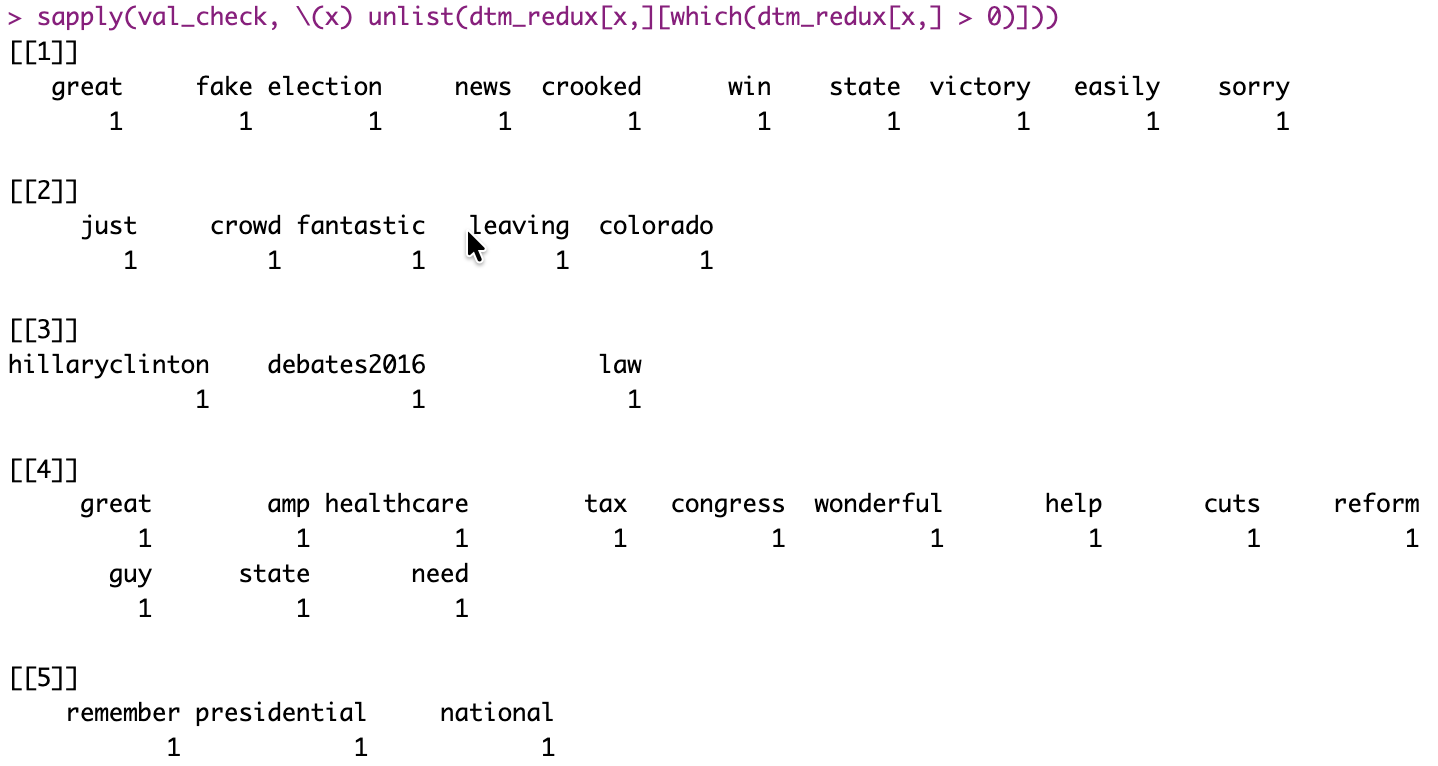
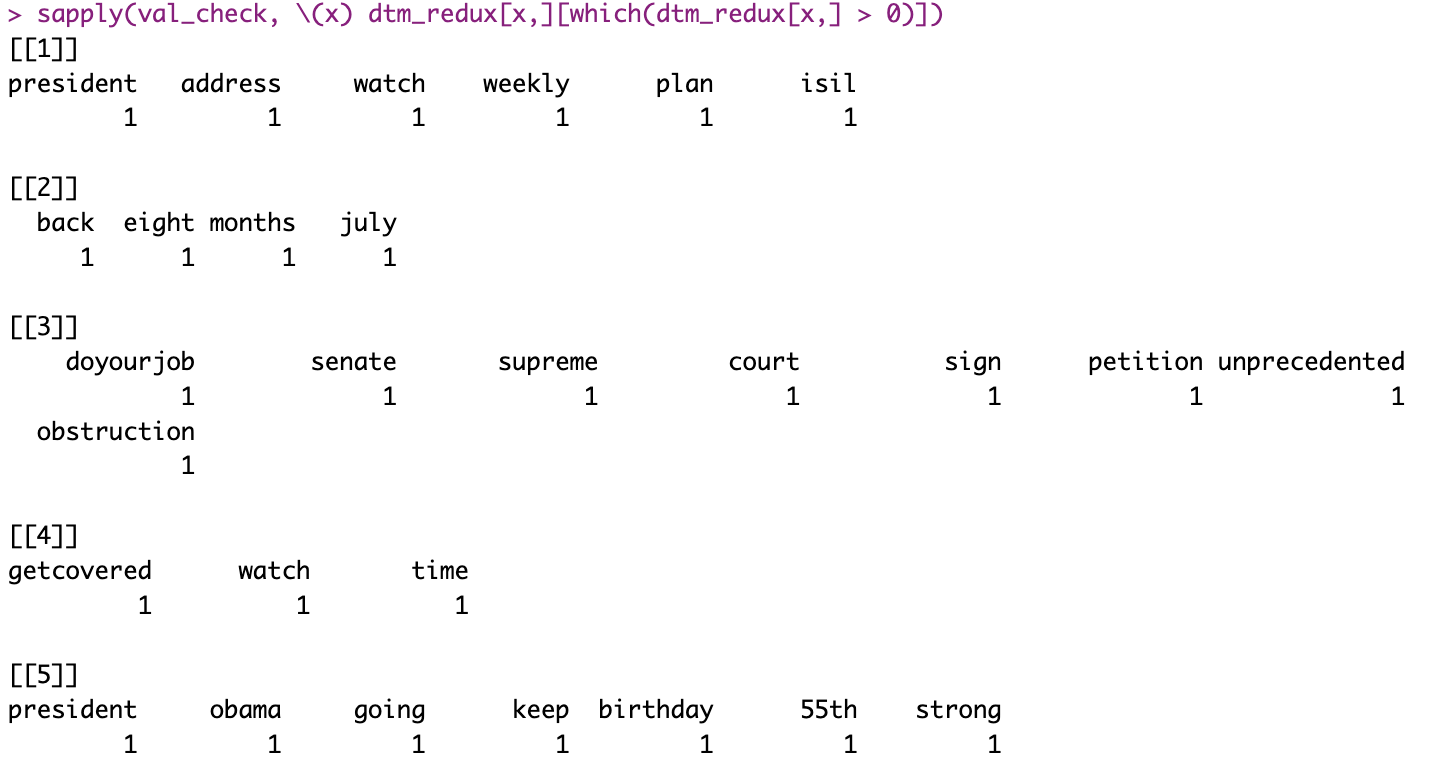
OK so clearly this is not “enough”, and yet…
Conclusions
Maybe it’s all a stupid/bad idea. I need to keep working on it for a while and see. It looks somewhat promising thus far though.
If I managed to come up with even a few simple rules to help classify correctly a few thousand unclassified samples, that would be huge a win already, so it’s worth a try. And if i manage that without any of the more complex stuff above, well, all the better. I’ll obviously try to work manually through the data first, get a sense of it. Although if it were easy… it would be done already, I guess.
Plus, and for me the fun part: it would be a practical application of my hobby for a real need at work. But it might well end up being more of a (possibly failed) weekends research exercise, rather than an actual project… Only time will say if I manage to put something together.